US
METRIC
DetailsModel Mayhem #:
571052
Last Activity:
Apr 18, 2023
Experience:
Very Experienced
Compensation:
Depends on Assignment
Shoot Nudes:
Yes
Joined:
Nov 19, 2007
Age:
69
Height:
6' 3"
Weight:
220 lbs
Neck:
18"
Sleeve:
35"
Chest:
46"
Waist:
34"
Inseam:
34"
Shoe:
13.0
Ethnicity:
Skin Color:
White
See More Details
Eye Color:
Blue
Hair Length:
Short
Hair Color:
Brown
Tattoos:
None
Piercings:
None
See Less
Friends (132)About Me
“DAEDALUS AND ARIADNE”: portrayed by Peter Allemano and Helen Allemano
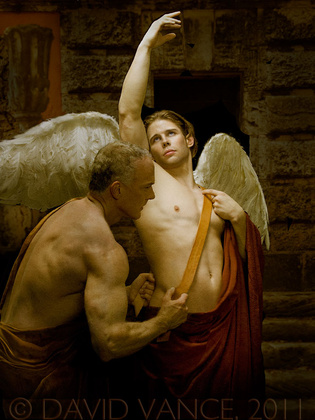
Concept conceived by Peter Allemano; developed and executed by David Vance; photo taken in Miami, Florida on 2/8/13 (© David Vance 2013). 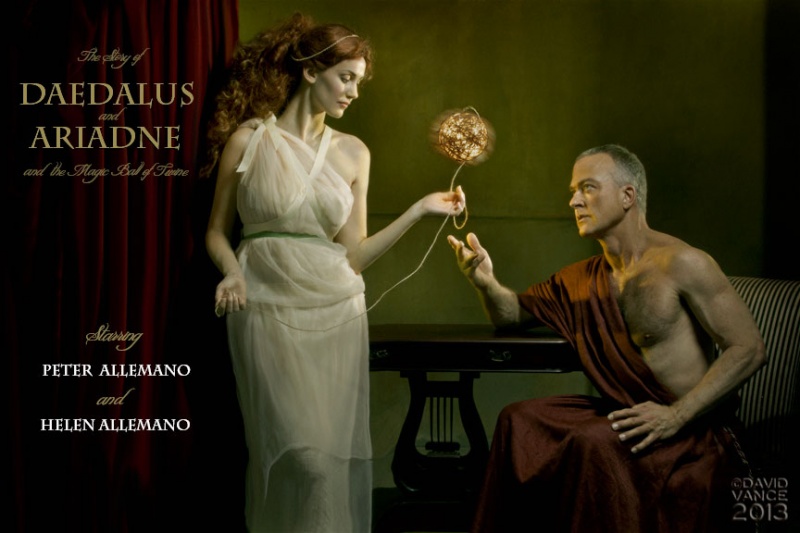 Quite possibly, ours is the first-ever illustration of the clandestine meeting, in Greek mythology, between Daedalus and Ariadne. Both characters are famous and have dramatic histories, and both have been the subjects of illustrations by many artists, over the centuries. But neither David Vance nor I — nor a professor of art history who was asked for her assistance — could locate any prior art that depicted these two characters together, at this intersection of their respective lives. Our illustration depicts Ariadne, the princess of Crete, successfully persuading the master Athenian craftsman Daedalus — who lives in exile in King Minos’s court — to become her ally in a scheme against her father. Daedalus must know that, by giving Ariadne the magic ball of twine, he is likely to suffer unhappy consequences. Indeed, he does: his own son, Icarus, winds up dead. But Daedalus enters into the scheme with Ariadne anyway. “DAEDALUS AND ICARUS”: portrayed by Peter Allemano and Andrew Aponick Concept conceived by Peter Allemano; developed and executed by David Vance; photos taken in Miami, Florida on 12/11/11 (© David Vance 2011). 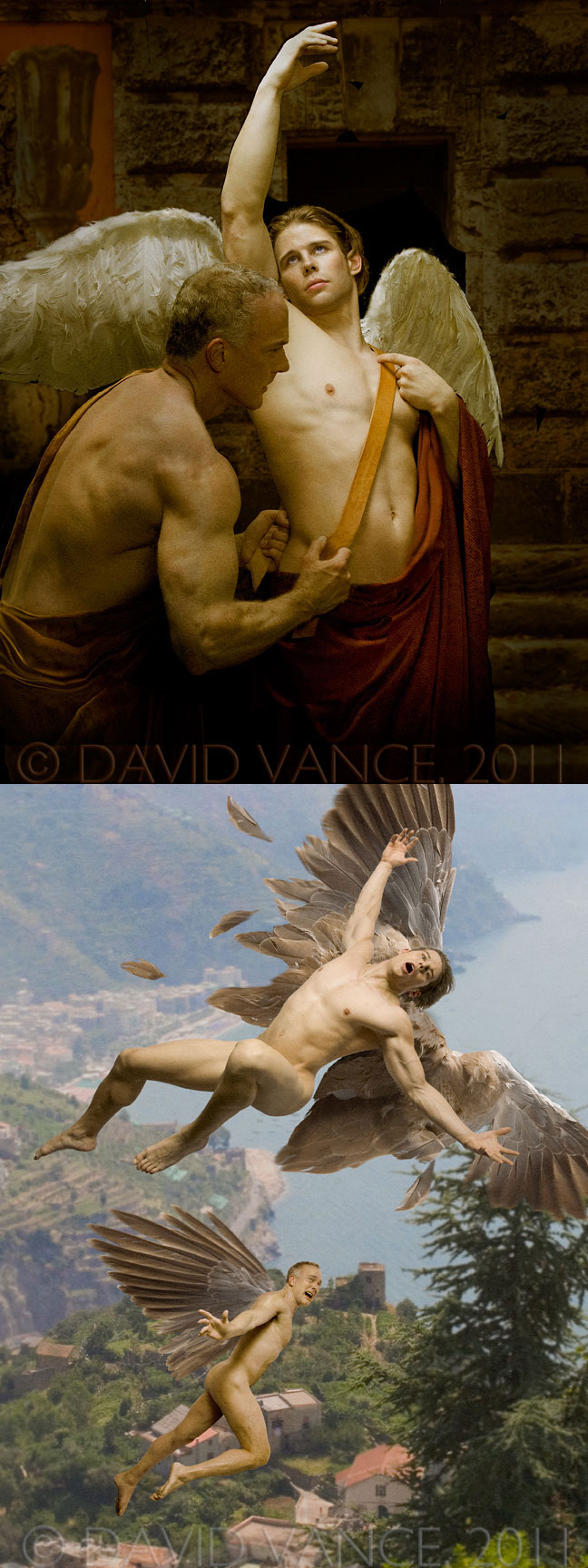 DEDICATION BY PETER AND ANDREW: Our representations of “Daedalus and Icarus” honor the memory of brothers Louis (“L.J.”) Knutson (1981 – 2010) and Jason Knutson (1986 – 2011) — fine young men whose lives ended far too early. Please honor their memory too with your generous support of the National Coalition For Men. For behind-the-scenes photo highlights of the “Daedalus and Icarus” creative process, look here. Please read my article on mainstream media representations of men and boys, published in New Male Studies. You can download the PDF file here. * * * * * The myth of “Daedalus and Icarus” has fascinated writers and artists for centuries, and it has been re-told and illustrated in a multitude of variations. Daedalus was a master Athenian craftsman who lived in exile — with his beloved son Icarus — in Crete. When Daedalus fell out of favor with King Minos, father and son were imprisoned. Daedalus decided that he and Icarus had to leave Crete and get away from Minos, before he brought them harm. However, Minos controlled the sea around Crete and there was no route of escape there. Daedalus realized that the only way out was by air. To escape, Daedalus built wings for himself and Icarus, fashioned with feathers held together with wax. One of the most poignant accounts of what happened next is by Thomas Bullfinch (1796 – 1867): When at last the work was done, the artist, waving his wings, found himself buoyed upward, and hung suspended, poising himself on the beaten air. He next equipped his son in the same manner and taught him how to fly, as a bird tempts her young ones from the lofty nest into the air. When all was prepared for flight he said, “Icarus, my son, I charge you to keep at a moderate height, for if you fly too low the damp will clog your wings, and if too high the heat will melt them. Keep near me and you will be safe.” Verified Credits (1)Worked with Peter Allemano? Share your experience and become verified! Add Credits"Peter is a wonderful model to work with and I consider him a favorite . Peter is both handsome and very sexy . He is also a very intelligent and nice man . I have shot with him a few times and had excellent results from all my experiences with him . I hope to work with him many more times . Peter is an all round great guy !!!!" Read less
...
Read more

See 5 More
See Less
See All Verified Credits (1)
Credit Notes
2021 UPDATE: Thanks for stopping by my profile! But please be advised that — for the foreseeable future — I am not available for modeling.
* * * * I had considered myself semi-retired from modeling for quite a while when I joined ModelMayhem in November 2007, and I did so as a dare to myself — and to celebrate my return to function subsequent to a catastrophic brain injury. At the height of my professional modeling career, I had agency representation in eight countries. Most (but not all) of my work was in “commercial” print. I don’t know why (maybe I’ve got a so-called “honest face”), but I appeared in ads for more European banks — from Switzerland to Norway— than I can remember. Just for the fun of it, I’ve posted two collages in my port with images from my youth. I hope you enjoy looking at them! One image, as you’ll see, is from what I mischievously enjoy referring to as my “most glamorous” professional gig: a TV commercial for Nescafé, shot in Vienna aboard the world famous Orient-Express. But the train never left the station, the nighttime sky outside the dining car window was just a piece of black construction paper, and my beautiful female partner couldn’t speak English. Additionally, the tux was a rental, and — because the shot was only from the waist up — I dispensed with putting on the trousers and instead wore blue jeans (and sneakers too!). To top off all this “glamour,” at the end of the day I rode the subway home to my apartment like any other working bloke. Since joining ModelMayhem, the focus of my modeling projects has rarely been “commercial.” Instead of trying to shoe-horn myself into a visual persona that will appeal to casting directors, I seek to collaborate in creating images that are (hopefully) beautiful, fun, sometimes a wee bit provocative — and that occasionally contain a dimension that is didactic. I’m having a blast! Tags
Yazlovetska Retoucher
· Retoucher
Hello! 
Joshua Liberman
· Photographer
I like your port! :) 
AliceRetouch
· Retoucher
Hello, you have a very beautiful portfolio, I am a retoucher, if you need my help, I will be happy to help you. my email: [email protected] 
Male Reflections
· Photographer
Top notch port!! 
The Male Fotograf
· Photographer
Terrific portfolio; I'd love to work with you sometime. If you're interested, let me know!
|